Why Is Cheese’s Shape Almost Always Round?

If you walk into almost any cheese shop in the world, you will notice something immediately: cheese is usually round. Wheels, drums, discs, cylinders. From Italy to France to Spain, the dominant form repeats itself.
Is that a coincidence? Did cheesemakers experiment with other shapes? Is there a reason cheese became circular? And do these rules apply to farmers cheese too?
To understand why cheese looks the way it does, we have to go back to how cheese was made before factories, stainless steel, and refrigeration.
Why Cheese Became Round
Historically, most aged cheeses were made in wooden molds called hoops. These hoops were circular for a simple reason: wood bends naturally into round shapes more easily than sharp angles. A continuous strip of wood could be shaped into a circle and secured. Making a square mold required joints, corners, and reinforcement. That meant more labor and more failure points.
There is also a structural reason. A circle distributes pressure evenly. When curds are pressed to remove whey, uniform pressure prevents cracks. Cracks allow unwanted bacteria and mold to enter. A round cheese ages more predictably because the force applied during pressing spreads evenly across its surface.
Another practical explanation relates to rind development. Many traditional cheeses form a natural rind during aging. A circular wheel has no corners. Corners dry faster. Faster drying creates uneven aging. Over time, cheesemakers learned that round forms produced more stable results.
The idea that cheese is round because it rolls is partially true, but secondary. Large wheels such as Parmigiano Reggiano could indeed be rolled for transport, but that was a benefit, not the original reason for the shape.
There is also a persistent rumor that medieval taxation influenced cheese shapes. Some historical records suggest that certain regions taxed cheese by size or by mold type. While not the primary reason for circular forms, regulations did encourage standardization. Standard molds meant predictable volume and trade measurement.
So yes, people experimented. But practicality won.
Did Cheesemakers Try Other Shapes?
Absolutely. As production methods evolved, different shapes appeared depending on how the cheese aged and how it was consumed.
- Brie – Wide, flat discs. This format supports surface mold ripening. A thinner body allows the white mold to develop evenly from rind to center.
- Manchego – Compact drum with a patterned rind. The design comes from traditional woven grass molds used during pressing in Spain.
- Crottin de Chavignol – Small rounds. The reduced size allows faster drying and staged aging.
- Cheddar – Frequently block-shaped today. Industrial slicing and packaging benefit from straight edges and uniform stacking.
- Gorgonzola – Tall cylinders. The height supports controlled oxygen exposure, which is necessary for internal blue veining.
Each form reflects function. Shape follows aging method, drainage needs, and handling requirements.
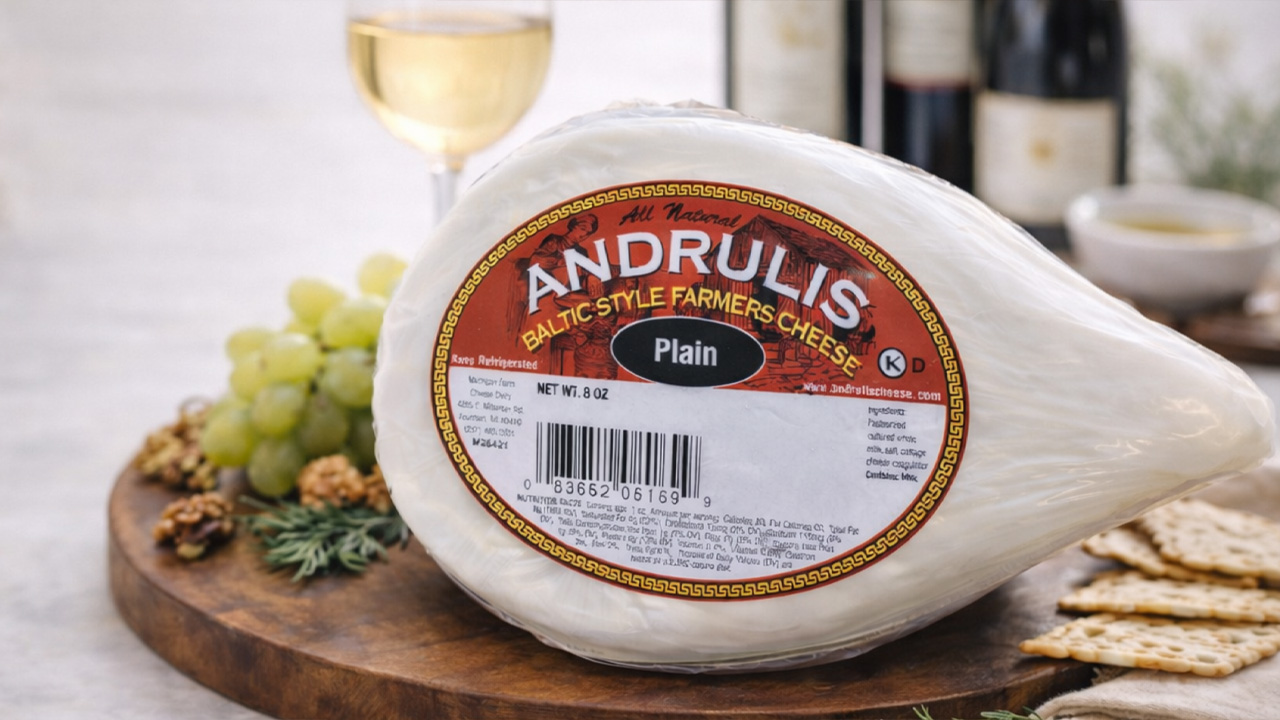
In contrast, Andrulis Farmers cheese does not imitate a traditional wheel. Its structure visually reminds many people of pressed cheese curd, which connects directly to how fresh curd is gathered and formed during production.
What Is Farmers Cheese and Why Is It Not Round?
What is farmers cheese? It is a fresh, pressed cheese made from cultured milk. It does not rely on long aging or rind development. Because it is consumed fresh, it does not require the structural advantages of circular molds.
When we ask how to make farmers cheese, the answer explains the shape. Fresh curds are drained in cloth and pressed under flat surfaces to remove whey. Flat pressure produces flat sides. Cloth wrapping forms a compact mass rather than a wheel.
On a traditional cheese farm, practicality determined form. Farmers cheese was made for daily use. It needed to slice easily. It needed to stack efficiently. It did not need to age in a cellar for months.
Rectangular and loaf-like shapes make sense for fresh cheese because:
- They drain efficiently during pressing
- They store well in refrigeration
- They are easy to portion
- They reduce breakage during handling
Let’s look at how it goes at Andrulis.
We do not have a structural reason to keep our cheese in a circular shape. Farmers cheese does not depend on rind aging or oxygen flow. We shape it in a way that supports natural pressing and practical storage during production. And over time, that specific Andrulis Farmers cheese form became recognizable on the shelf.
What started as functional became identity.